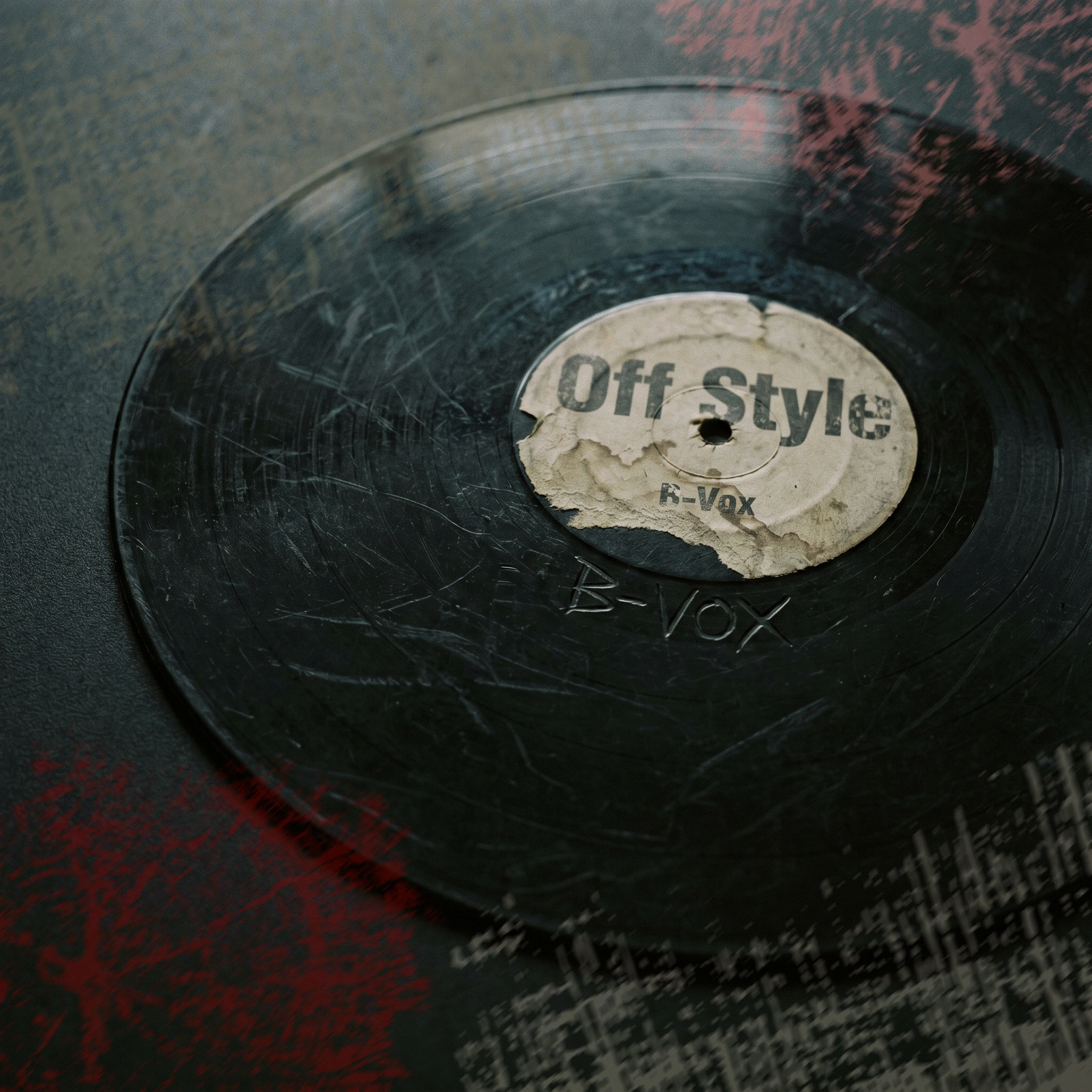
Off Style
If you had to describe «Off Style» in one word, that word would be «bipolarity».
Ten tracks, listed on the platform as «Trip-Hop», are in fact a kaleidoscope of pop-house, synthwave, cinematic indie-rock, lo-fi hip-hop and industrial techno — but the album's defining feature isn't the variety itself, it's how that variety is organised. B-Vox don't split the record into «light» and «dark» halves; they edit it cinematically, constantly butting opposite moods up against each other from one track to the next, as if flipping channels between a summer-resort radio station and a transmission from a factory bunker.
The album begins deceptively smoothly: «Before the "After" Comes» — textbook Deep House with elements of Slap House and Tropical Pop, rubbery bass, fingerpicked guitar and a breathy female vocal. A flawless radio-ready statement, golden-hour music that promises the listener a light, sunlit journey.
And immediately that promise is smashed. «Reflection», the second track, is experimental hip-hop at the seam of industrial and glitch: no melodies, no verses or choruses, just a looping distorted groove and a male recitative that sounds like an interrogation in a dystopian bunker. The transition from track one to track two is arguably the sharpest stylistic leap you could put on a single album, and B-Vox make it literally in the album's second minute. The rules of the game are set right there: nothing is predictable here.
«Deus ex Machina» pulls the album back into the light, but in a different register — cinematic indie-pop/soul-rock that starts as an intimate confession over acoustic guitar and gradually grows into a stadium hymn with choir backing and the incantation «God protect me». One of the most emotionally saturated tracks on the album, staking out Hozier / Imagine Dragons territory.
After that peak — a breath: «Disappointment», a purely instrumental lo-fi hip-hop / jazz-hop in the spirit of Nujabes, music for background and contemplation. The contrast with the preceding track works like a lungful of air after the catharsis.
«Lazy Jimi» pulls the album back onto the dancefloor — bright, optimistic tropical house with sidechain, acoustic guitars and memorable vocal chops. The album's most «carefree» moment, a kind of sonic mirror of the opener.
But the reprieve is short: «Seeking the Calm» — where the title functions as black irony. A slow, oppressive lo-fi phonk / industrial rap with overdriven 808 bass and a «telephone» vocal, sounding like a walk through an abandoned factory in a thunderstorm. There is no calm here — only weight and claustrophobia.
«Deacon's Waltz» abruptly switches the tone to nostalgic synthwave — hypnotic mid-tempo, gated reverb on the drums, singing guitar solos, an enveloping male vocal. After the industrial weight of the previous track this sounds almost like solace — music of a night drive and neon lights, warm and cinematic.
The solace doesn't last: «Reflection pt.2» is the most chaotic thing on the album, a kaleidoscopic mix of industrial techno, hyper-trap and dark electronic with sharp dynamic shifts and a sound that literally travels between channels. An escalation of everything the first «Reflection» laid down, pushed to the limit.
«Tears on the Glass» is a large-scale cinematic industrial techno canvas with nods to Gesaffelstein and «Blade Runner»: deep mechanical vocal, booming hits, a gradual escalation of density into a grand climax. Dramatically it's a mirror of «Deus ex Machina», but inverted into a cold, dystopian key — the same arc from quiet to vast, only in industrial rather than organic tones.
The album is closed by «Nothing at all, dear» — melodic techno in the spirit of Anyma and ARTBAT, a slow burner with wordless female vocalise and a massive analogue bass. After all the contrasts and collisions this is perhaps the most «reconciling» point: hypnotic, meditative, leaving a long echo behind it — a track at once danceable and contemplative, which makes it the ideal finale for an album built on contradictions.
«Off Style» isn't an album in two halves; it's a pendulum album. B-Vox keep swinging the listener between poles: light and dark, dance and meditation, warmth and metal, hope and paranoia. By the second minute it's clear that predictability isn't on offer, and from there the album honestly keeps that promise across all ten tracks.
Technically every cut is delivered at a very high level of production — regardless of genre, the sound is dense, spacious, considered. But it's exactly this stylistic turbulence that will be the album's main fault line among listeners. For some it's a bold, conceptual portrait — a sound-map of an inner world where joy and anxiety exist simultaneously and constantly interrupt each other. For others it'll read as a lack of focus and overly sharp, unprepared transitions that prevent the album from being heard as a single piece rather than a collection of unrelated singles.
Listening to «Off Style» from start to finish requires a certain readiness for emotional swings — but it's precisely in that unpredictability that the album's main case in its own defense lies.
Strengths: variety, production, two genuinely strong «dramatic» tracks («Deus ex Machina» and «Tears on the Glass»), boldness in sequencing.
Weaknesses: an absence of transitional / connective material between contrasting tracks; the risk that the sharp stylistic leaps will push away listeners looking for a unified sound.
For: those who value album-journeys with unpredictable dramaturgy and aren't afraid of sharp emotional contrasts — and separately, fans of tropical house / synthwave / cinematic indie (the light tracks) and industrial techno / experimental hip-hop (the dark tracks).